


Our top choice for VPN in 2026 is NordVPN. Speed, security, and prices are all balanced. The right VPN depends on what you need.
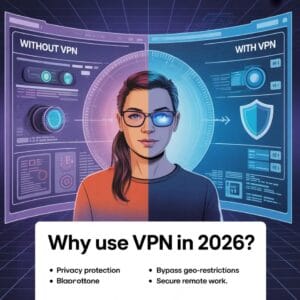
Why You Still Need a VPN in 2026:
You might have heard people say, “VPNs are dead.”Don’t believe them.
Most websites are encrypted now. Your internet provider can still see every website you visit.
Advertisers create profiles based on your browsing.
If you have used Wi-Fi, you have exposed yourself.
- A reliable VPN fixes all of that.
- It hides your IP address.
- It makes you invisible to strangers.
- You can access geo-restricted content.
- It protects you on networks.
The Market in 2026:
There are hundreds of providers.
Most of them are not worth your time.
This guide gives you the seven that actually work.
How We Tested These VPNs:
We tested speed, security, and price.
We checked for DNS leaks and WebRTC leaks.
We tested streaming on Netflix, BBC iPlayer, Disney+, and Amazon Prime.
We looked at app quality and customer support.
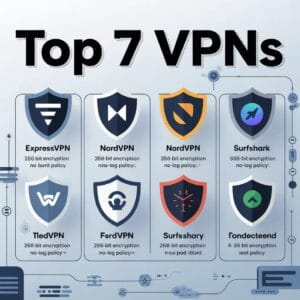
The 7 Best VPNs in 2026:
1. NordVPN is the Best VPN. Overall:
- Rating: 5 out of 5
- Cost: Starting at $3.09 per month
- More than 6000 servers in 111 countries.
- It has speed and excellent security.
- It unblocks Netflix, BBC iPlayer, Hulu, and Disney+.
- It blocks malware threat protection features.
2. ExpressVPN. Fastest VPN in 2026
- Rating: 5 out of 5
- Cost: Starting at $6.67 per month
- More than 3000 servers in 105 countries
- It has a secure connection.
- It is perfect for gaming and large file transfers.
3. Surf Shark. Best Budget VPN
- Rating: 4.5 out of 5
- Cost: starting at $2.19 per month
- More than 3000 servers in 100 countries.
- It has connections.
- It blocks ads and malware.
4. Private Internet Access (PIA). Best for Privacy:
- Rating: 4.5 out of 5
- Cost: from $2.03 per month
- Servers: 35,000+ in 91 countries.
- PIA is the best VPN for privacy.
- It has a server network.
- It has proven its no-logs policy in court.
5. CyberGhost: Best for Streaming
- Rating: 4 out of 5
- Price: from $2.19 per month
- Servers: 9,700+ in 100 countries.
- Cyber Ghost is perfect for streaming.
- It has dedicated streaming servers.
- Netflix, BBC iPlayer, Disney+, and Amazon Prime are all unblocked.
6. Proton VPN. Best Open-Source VPN
- Rating: 4 out of 5
- Cost: from $4.99 per month
- Servers: 9,000+, in 112 countries.
- Proton VPN is an open-source VPN.
- It has a policy.
- It has a no-log policy.
Additionally, Proton VPN provides a free VPN plan with no data limits, which is quite rare and worth mentioning for anyone who needs to use a VPN lightly without paying a dollar.
It’s pretty competitive in speed. The pricing is on the higher side compared to what you get with Nord VPN.
Best for: People who care about privacy, journalists, activists, and open-source fans.
Pros:
- It is based in Switzerland
- open source
- Has a Stealth protocol for censored areas
- Provides a tier
- Has audits
Cons:
- More expensive than similar competitors
- Has a server network at lower price tiers
7. IP Vanish Best for Tormenting
- Rating: 4/5
- Price: from $2.99/month
- Servers: 2,400+ in 90 countries
In the P2P world, IPVanish is well-known and user-friendly. All of its servers support tormenting, which is not something that every provider can claim. It also allows simultaneous connections on all plans, just like Surf Shark.
IP Vanish, which has been owned by Ziff Davis since 2019, is controlled by US law, which some privacy advocates find concerning, given the country’s surveillance laws.
That being said, the company maintains a no-logs policy and has not been involved in any data disclosure incidents.
The speeds are excellent, and the apps are clean. It works reliably across platforms. It is not the option on this list, but it’s dependable and reasonably priced.
Best for:
- Tor renters
- Users who need device connections
- Anyone looking for a simple, everyday VPN
Pros:
- Full P2P support
- Unlimited connections
- Competitive pricing
- Clean apps
Cons:
- US jurisdiction
- Consistent streaming performance
- Less advanced features than competitors
How to Choose the Right VPN for You:
Everyone has a different demand when it comes to VPNs.
Here is a way to narrow it down:
- If you want the best overall experience, go with NordVPN.
- If speed is your top priority, choose ExpressVPN.
- If you need to provide for a household on a limited budget, Surfshark is your perfect option.
- If privacy is your concern and you want proven no-log credentials, pick Private Internet Access.
- If you mostly want to stream geo-blocked content without any setup, CyberGhost makes it effortless.
- If you’re politically active, a journalist, or you live under internet censorship, Proton VPN’s Swiss base and Stealth protocol make it the right call.
- If you download torrents regularly, IPVanish gives you P2P-friendly servers across the board.
They are one tool in a broader privacy toolkit, not a magic shield.
Frequently Asked Questions:
1. Are VPNs in 2026?
In some countries, yes.
VPNs are legal and widely used for legitimate privacy and security purposes across the US, UK, Europe, Canada, and Australia.
Some countries. Including China, Russia, and the UAE. Limit the usage of a VPN without permission.
Always check the laws in your country before applying one.
2. Will a VPN slow down my internet?
There will always be some speed reduction because your traffic is being secured and routed through a server.
The slowdown is usually 10–15% when using a premium version like NordVPN or ExpressVPN. Not noticeable in daily use.
3. Can I watch Netflix using a VPN?
Yes, the majority of VPNs on this list can unblock Netflix and other streaming platforms.
CyberGhost and Nord VPN are dependable for this use case.
Note that streaming services constantly try to block VPN traffic. No VPN provides 100% uptime with 100% of services.
4. Is a VPN Efficient?
ProtonVPN is highly reliable for light users.
Most other free VPNs, however, have disadvantages. Data caps, slow speeds, limited server options, or, in some cases, charging for your data.
Using a paid VPN is worth the investment.
5. What is a no-logs VPN?
Your activities are not recorded by a no-logs VPN. No browsing history, no connection timestamps, no IP addresses.
The top providers support this agreement with audits, and some (like PIA) have had it proven in legal proceedings.
6. How many devices can I link to one subscription?
It varies by provider.
Surf Shark and IP Vanish offer connections.
NordVPN allows 10, ExpressVPN allows 8, and ProtonVPN differs by plan.
Review the plan details before purchasing if you have devices.
7. Are VPNs secure from hackers?
A VPN protects your connection. On public Wi-Fi. By securing your traffic and hiding your IP.
It offers no protection against scams, malware, phishing attacks, or weak passwords.
Think of it as one layer of security, not a complete solution.
Summary:
The top-notch VPN in 2026 is still NordVPN for people.
It’s fast, trustworthy, reasonable, and effective out of the box for streaming, privacy, and everyday security.
Express VPN is the choice if you need the fastest speed and don’t mind paying more.
Surf Shark wins on value for larger households.
- Whatever you choose from this list, you’ll be in good hands.
- The days of VPNs being slow, clunky, and difficult to configure are behind us.
- The options above are all fast, user-friendly, and genuinely private, which is what a VPN in 2026 should be.
