


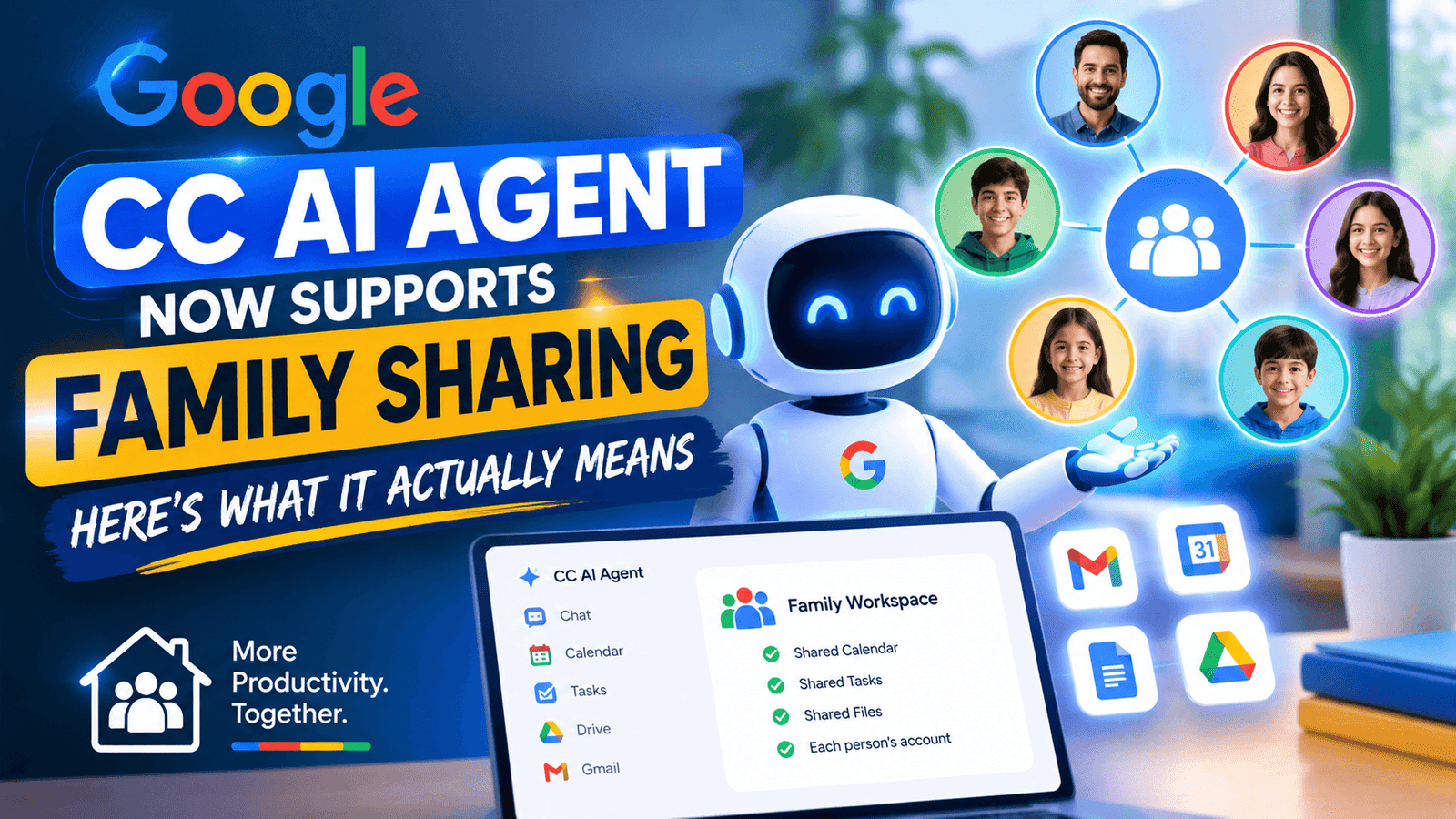
I’ve been following Google’s CC experiment pretty closely since it first launched back in December, mostly because I use a version of it myself just to keep my own freelance schedule from completely falling apart. So when news broke this week that Google’s expanding CC into a shared AI agent for families, I actually read through the details instead of skimming headlines. And honestly, this is a bigger shift than it looks at first glance.
What Google CC Actually Is: Quick Recap:
For anyone who missed the original launch: CC is an experimental AI productivity agent from Google Labs, built on Gemini. It connects to your Gmail, Calendar, and Drive, then sends a daily email called “Your Day Ahead” summarizing your schedule, flagging important tasks, and reminding you about bills or upcoming appointments. You reply directly to that email to give it new instructions, ask it to draft something, or tell it to remember an idea for later.
It’s not a chatbot you open up and talk to. Works quietly in the background and shows up once a day in your inbox. Honestly, that’s part of why I like it. No new app to check, no extra tab sitting open all day.
What’s Actually Changed Here?
Google’s expanded CC so it now supports up to six people, turning it from a personal productivity tool into something closer to a shared household agent. Instead of managing just one person’s calendar and inbox, CC can now coordinate across multiple family members. Who’s picking up groceries? When’s the kid’s school event? Whose turn is it to handle a shared bill?
Reading through the coverage, it’s pretty clear Google’s positioning this less as “your personal assistant” now and more as a household coordination layer, something in the same neighborhood as what Google Home or Alexa attempts for smart devices, except this one lives quietly in your inbox and actually understands the messy, overlapping context of running a household.
Why This Is a Bigger Deal than the Headline Suggests:
Easy to read something like “Google expands AI agent to six users” and just shrug it off. But think about it for a second. Most AI tools right now are built around one person talking to one model. What Google’s doing here is different. It’s building a system that has to understand and reconcile the schedules, priorities, and responsibilities of multiple people at once, without the whole thing turning into chaos.
That’s a genuinely harder problem than a solo morning briefing. Who’s responsible for what? What happens when two people’s calendars conflict? How much visibility should one person have into someone else’s schedule? Google hasn’t spelled all of this out publicly yet, but the fact that they’re even attempting it says something about where this category of product is headed.
Where this Fits in the Bigger AI Agent Race:
This lines up with something I’ve noticed across the industry this year generally. Everyone’s racing to move AI from “answer my question” toward “actually manage part of my life.” OpenAI tried something similar with ChatGPT Pulse’s morning briefings. Microsoft’s leaning hard into Copilot across Office 365. Apple’s taking the slower, more cautious route with Siri’s expanded capabilities.
Google’s edge here is obvious once you actually think about it. They already sit inside hundreds of millions of people’s Gmail and Calendar accounts. Nobody has to migrate to a new platform or grant a fresh batch of permissions from scratch. CC just taps into infrastructure that already exists, and now that advantage gets stretched across entire households instead of just individual users.
Should You Actually Care if You’re Not Using CC Yet?
If you run a small business or just manage a household with more than one moving part (which, let’s be real, is most households), this is worth keeping an eye on even if you’re not signing up right now. CC’s still an early-access Google Labs experiment, limited to Google AI Ultra subscribers and paid users in the US and Canada for now, so most people can’t even access it yet.
But this kind of shared, household-level AI coordination is almost certainly going to show up elsewhere soon, whether that’s Google expanding it further, a competitor building something similar, or one of the smaller AI tools already chasing families and small teams. Worth watching, especially if scheduling chaos is already a daily thing for you.
The Honest Caveat Here:
Google’s been upfront that CC can and does make mistakes, and it’s explicitly not meant to be relied on for medical, legal, or financial decisions. Sharing one AI agent across six people also opens up some fairly obvious privacy questions Google hasn’t fully answered yet. How much can one family member see of another’s schedule or communications? Worth thinking through carefully before jumping in, especially with teenagers involved or accounts where work and personal life overlap.
Still very much an early experiment, not a finished product by any stretch. But it’s a clear signal of where AI productivity tools are heading next and worth watching closely if you care about where this space is going.
