


I get asked this one constantly. Someone wants to hide their IP or get around a geo block, sees “proxy” and “VPN” thrown around like they mean the same thing in half the articles they read, and just picks whichever word sounds more familiar. Honestly, I don’t blame anyone for the confusion. Both tools change the IP address a website sees. But underneath that one shared trick, they’re built to do genuinely different jobs, and mixing them up can leave you with way less protection than you think you have.
So here’s the actual difference, in plain terms, and which one you actually need depending on what you’re trying to do.
The Core Difference, Stripped Down:
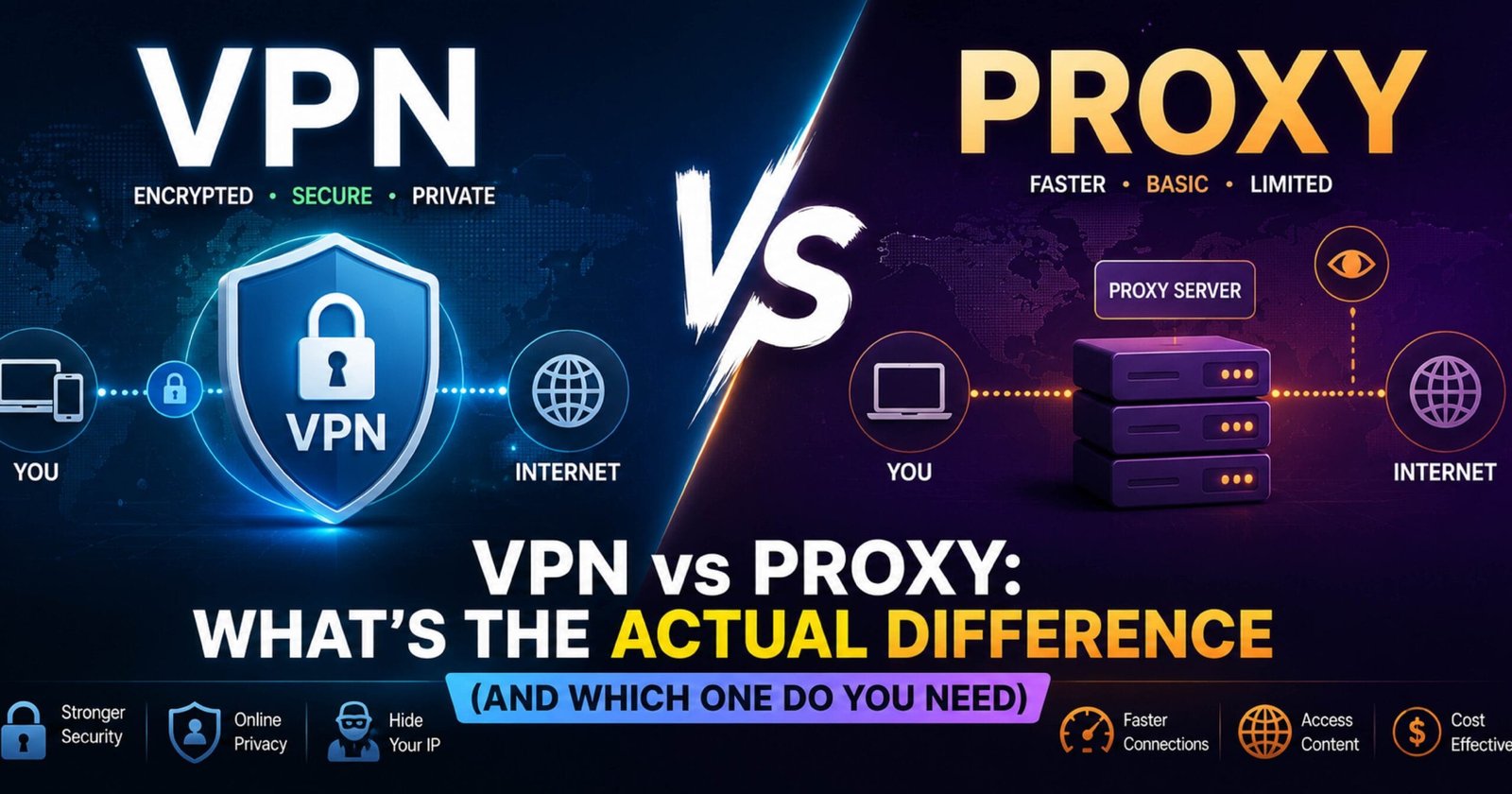
A proxy is basically a routing tool. It forwards your traffic through another server so the site sees a different IP, but it doesn’t encrypt anything, and it usually only covers whatever one app or browser you bothered to configure it for.
A VPN is a privacy and security tool. It encrypts everything leaving your device and sends it through a secure tunnel to a remote server, covering your whole device at once, not just a browser tab. Your internet provider, whatever sketchy public WiFi you’re on, or anyone trying to peek at your connection none of them can see what you’re actually doing once a VPN’s running.
That one thing, encryption versus no encryption, is really the root of almost every practical difference between the two.
VPN: What You’re Actually Getting:
A properly set up free VPN protects everything, not just your browser. That’s the part people underestimate until an app running in the background leaks their real IP anyway, because they assumed a proxy was covering the whole device when it was only ever covering one browser tab.
Pros:
- Encrypts all your traffic, not just browser activity
- Works at the device level, protects every app automatically
- Hides activity from your ISP and anyone else on the same network
- Better fit for everyday privacy, public WiFi safety, and streaming access
Cons:
- Usually needs dedicated software installed
- A bit slower than a proxy, encryption isn’t free
- Free VPNs come with real privacy tradeoffs more often than not
Proxy: What it’s Actually for:
Where a proxy earns its keep is scale. Need a thousand different IPs to spread requests across for scraping or account management? That’s a proxy’s job, not a VPN’s.
Pros:
- Lightweight, often just a browser setting, no install required
- Faster in a lot of cases since there’s no encryption slowing things down
- Better for tasks needing lots of different IPs at once, scraping, multi-account work, that kind of thing
- Easier on older or weaker devices since it uses fewer resources
Cons:
- No encryption at all, your data’s still visible to your provider and network
- Only covers whatever app you configured it for, not your whole device
- Free proxies specifically carry real risk; some quietly log or resell your traffic
When Each one Actually Makes Sense
If your goal is everyday privacy, safer browsing on sketchy WiFi, or getting into a streaming library that’s not available where you live, go with a VPN. The encryption is doing real, meaningful work here, and covering your whole device instead of just a browser matters more than most people realize, right up until something outside the browser leaks their actual IP anyway.
If you’re doing something like scraping, managing several accounts on one platform, or checking how ads or pricing look from different regions at scale, a proxy tends to fit better. Those jobs usually need a big pool of rotating IPs, which is exactly the thing proxy networks are built around. A VPN typically only hands you one IP at a time. A proxy service can give you access to a pool spanning dozens or even hundreds of countries.
Some people run both: a VPN for personal day-to-day browsing and proxies for specific business or technical work that actually needs IP rotation at scale. Nothing wrong with stacking them if you genuinely need both, though it does add complexity and can slow things down further.
A Quick Word on Free Options:
Free proxies deserve a healthy dose of skepticism. Since they skip encryption entirely and still need to cover their own costs somehow, your browsing data itself often becomes the actual product. If proxy access is genuinely what you need, paying for a reputable provider is worth it. The same general warning applies to free VPNs, though the risk looks a bit different there since encryption is at least happening; the real question becomes what the provider’s doing with your traffic behind the scenes.
Read More: https://compareshub.com/vpn/free-vpns/
Frequently Asked Questions:
Can a proxy do everything a VPN can? Not really. A proxy just changes what IP a site sees for whichever app you set it up for, and it skips encryption entirely. A VPN protects your whole device and encrypts everything leaving it, which is meaningfully more protection.
Is a VPN always the better choice over a proxy?
Not for every situation. For everyday privacy, yes, a VPN wins. But for jobs needing lots of rotating IPs, big scraping projects, or managing multiple accounts, proxies are genuinely the more practical and usually cheaper tool.
Why do proxies tend to be faster than VPNs?
Because a VPN encrypts every bit of your traffic before sending it through its tunnel, and that takes a small amount of processing time no matter how good the VPN is. A proxy skips encryption completely, which is faster, but it leaves your data visible to anyone watching the network traffic.
Do I actually need both a VPN and a proxy?
Most people don’t. If you’re just an everyday user focused on privacy and unblocking content, a VPN alone handles it. Proxies only really come into play for specific technical or business tasks, scraping, automation, multi-account work, situations most casual users never actually bump into.
Are free VPNs or proxies ever genuinely safe?
Be cautious with both, but especially proxies. A free proxy that skips encryption still needs to make money somehow, and often that means your data. Reputable paid providers, VPN or proxy, are almost always the safer bet if this actually matters to you.
Conclusion:
Short version. A VPN encrypts and protects your entire device, which makes it the right pick for everyday privacy, public WiFi safety, and streaming access. A proxy just swaps the IP one specific app sees, no encryption involved, which makes it faster and better suited to jobs that need a lot of rotating IPs rather than genuine privacy. Most people reading this for personal use want a VPN, full stop. Proxies really only shine once you’re doing something more specialized, and if that’s you, you probably already knew it before reading this.
